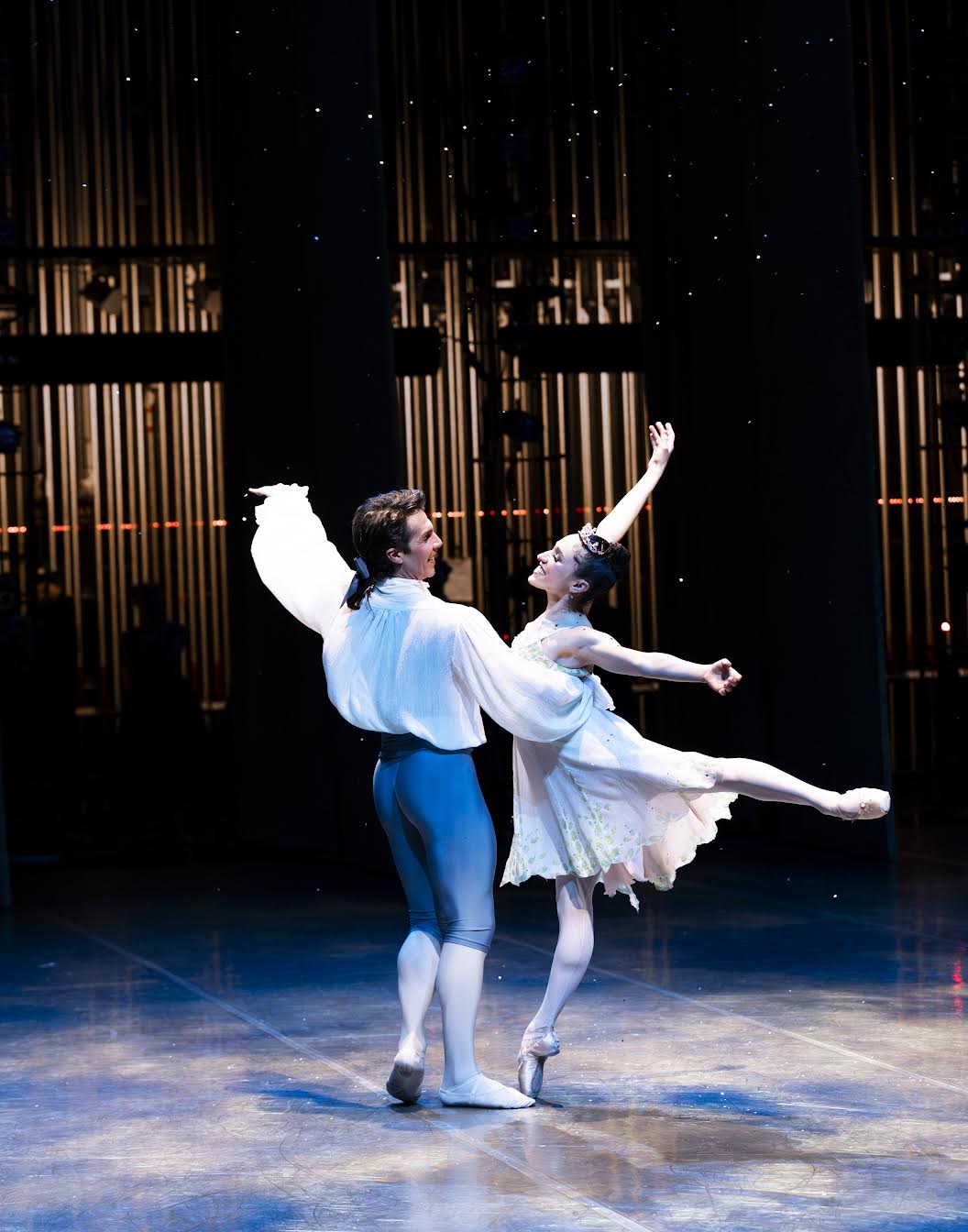
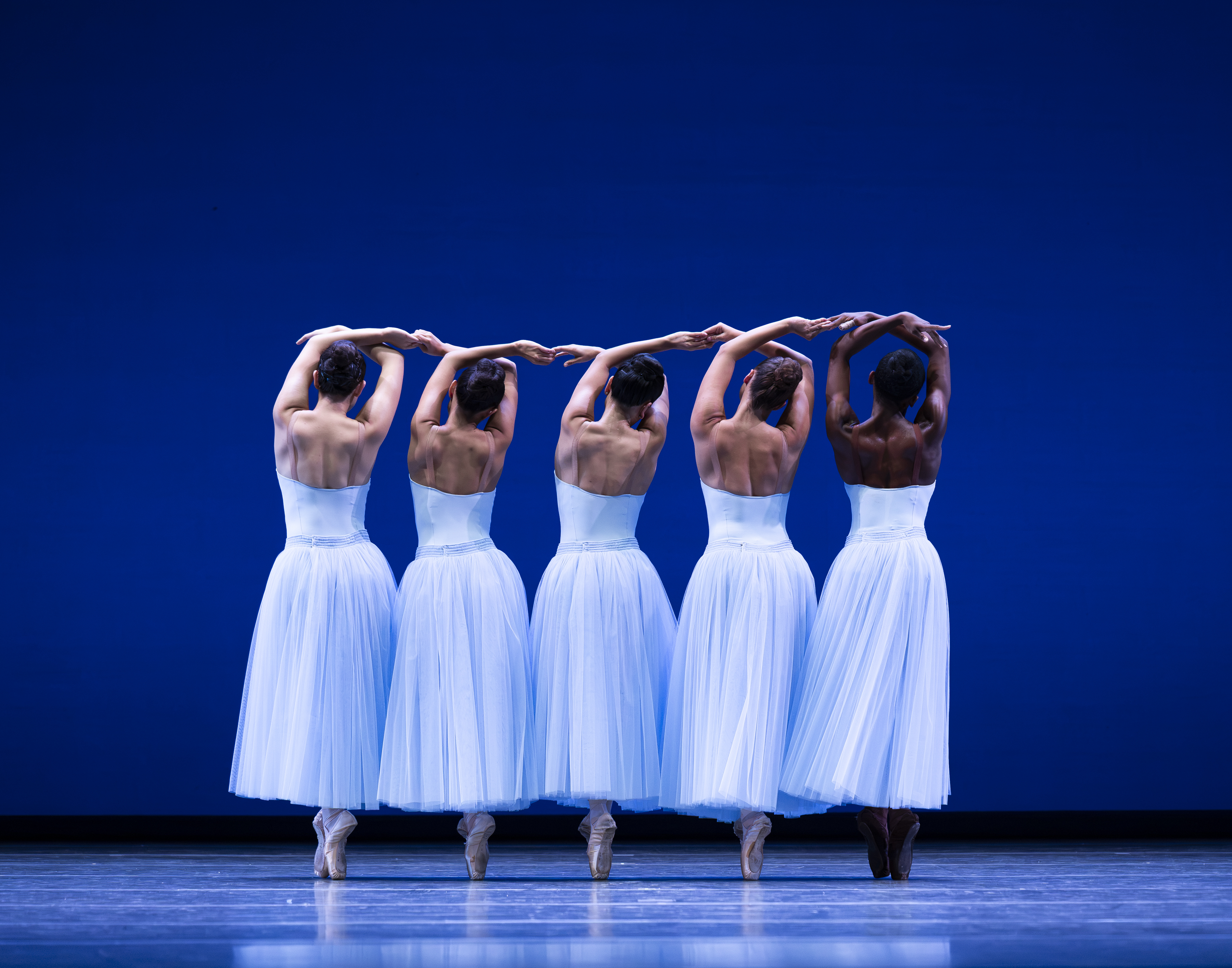
Pacific Northwest Ballet’s 2026–27 season kickoff brings us three reasons to live in the form of Serenade, a trio of ballets including a world premiere from PNB Resident Artist Jessica Lang, another look at Alexei Ratmansky’s Pictures at an Exhibition, and, of course, the titular offering from George Balanchine, the father of American ballet and chief finger appreciator.
The program runs through October 4 at McCaw Hall.
As usual, PNB Artistic Director Peter Boal picked three ballets that speak volumes to one another. This time, they’re talking about connections and disconnections, which made for an evening full of subtext and — in the case of Lang’s premiere — actual text. Together these ballets reveal the power of the collective moving as one, the brilliance of the multitudes that each of us contains, and the unique signature that only we will leave behind on the page, the stage, or the canvass.
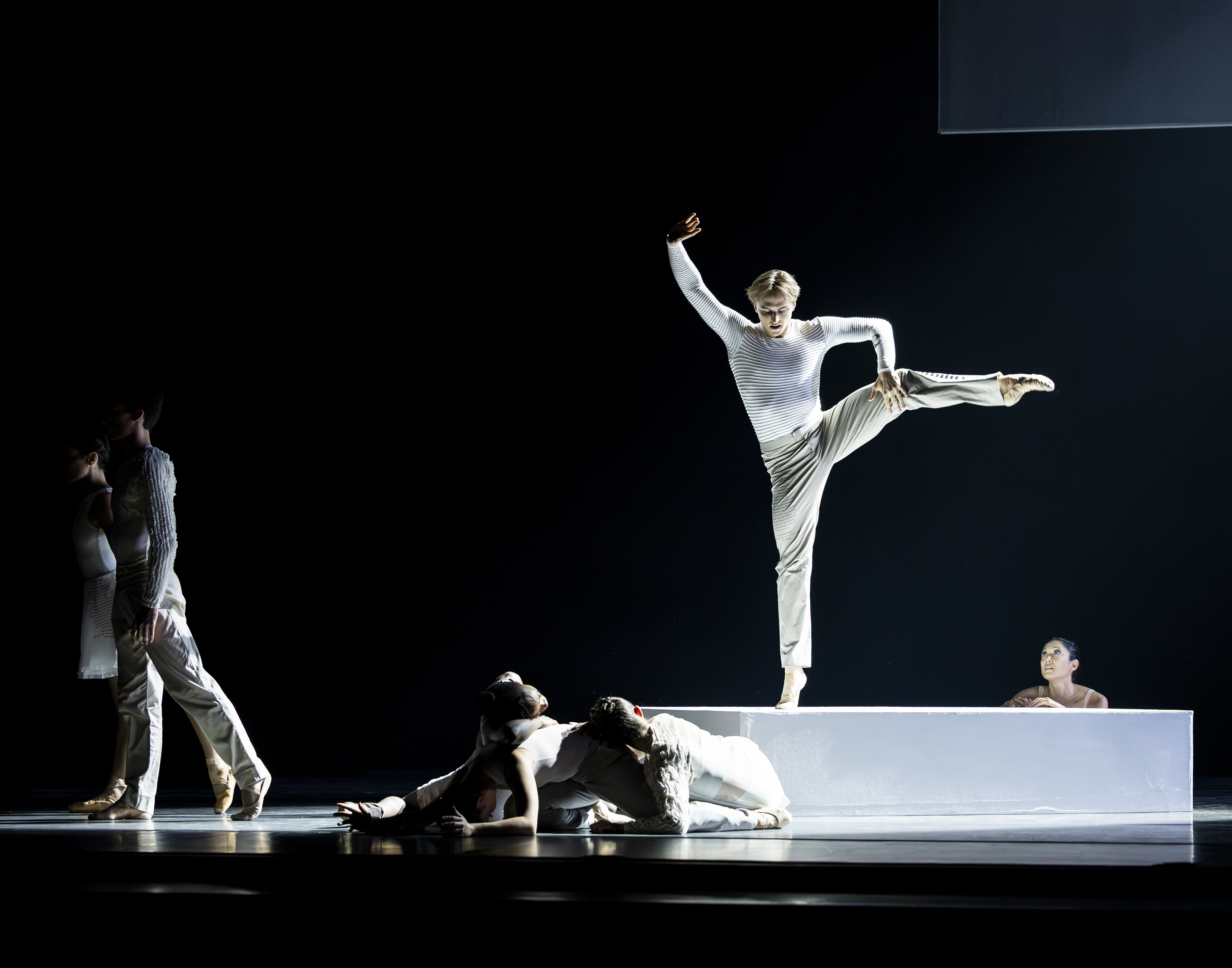
First up, Balanchine’s Serenade set the tone. This ballet showcases the company as a corps, challenging the principals and soloists to move as one. Though this piece does contain some impressive solo moments, it’s the collective ones that shine, such as the complex quintets and the geometric runs that looked like monochromatic kaleidoscope patterns. Christmas for those of us in the nosebleeds.
To the degree that any narrative shapes this modernist masterpiece apart from Tchaikovsky’s score, it’s famously neither linear nor particularly clear. A quick summary might go something like this: a company of dancers is born, then boy meets girl / girls, and then girl ascends to the heavens because she died a little bit?
The lore tells us Balanchine incorporated into the narrative a bunch of little mistakes that actually happened during rehearsals for the original production — a dancer arriving late, a fall — so it’s loose on purpose to keep the focus on the steps. Best to think of Serenade as one of those beauty-is-truth-truth-beauty ballets that wow you with a lot of impressively synchronized group numbers.
Three moments stood out on opening night. First, the stunning opener: a stage full of dancers hold their right hands up in exactly the same way, as if in defiance of the morning sun — all in updated, feather-light, sky-blue tulle tutus by Karinska. Woven from what looks like air, the long tulle skirts hovered after each leg extension, a ghostly third limb tracing lines across the stage.
Second came the moment I stopped taking notes: perhaps emboldened by new protections recently passed by the Seattle City Council, a handful of dancers let down their hair from high buns and performed as a kind of platonic polycule with Soloist Dammiel Cruz-Garrido.
Third was the moment everybody talked about during intermission: the femme quintet, where the dancers elegantly entangled their limbs, ran together, jumped together, and bowed together—all of it evoking some lost myth about the birth of sisterhood.
Throughout, PNB’s dancers demonstrated their command of this challenging material. There are not enough flowers on planet Earth to throw at Principal Leta Biasucci, who simply refuses to lose a step. In an early duet with Principal Christopher D’Ariano, she appeared to float across the stage as she executed a series of bourrées without making a sound or breaking a sweat. And in the concluding moments, when the crew lifted her into the air to deliver her to the afterlife (I guess?), she seemed to weigh nothing, standing stick straight as if she weren’t balancing on a couple of outstretched hands. I’m beginning to suspect that she made some kind of reverse Little Mermaid deal with a burlesque octopus, and I will be investigating this further.
Soloist Leah Terada also deserves a lot of foliage for her performance on opening night. She was effortlessly regal and mesmerizing in Serenade, and then she switched gears to lead the company in Lang’s world premiere, Pages, where she jumped three or four feet into the air onto boxes, moved at the speed of thought, and gave herself wholly to her character, fully embodying the artist-as-creator/artist-as-vessel psychodrama that drives the piece—but more on that later.
And it was impossible to miss corps de ballet dancer Melisa Guilliams entering the most elegant beast mode imaginable as she took on key roles in all three of these high-intensity numbers, showing off her considerable range, speed, and power. If I’m still writing “corps de ballet” next to her name around this time next year, I’m going to be PISSED.
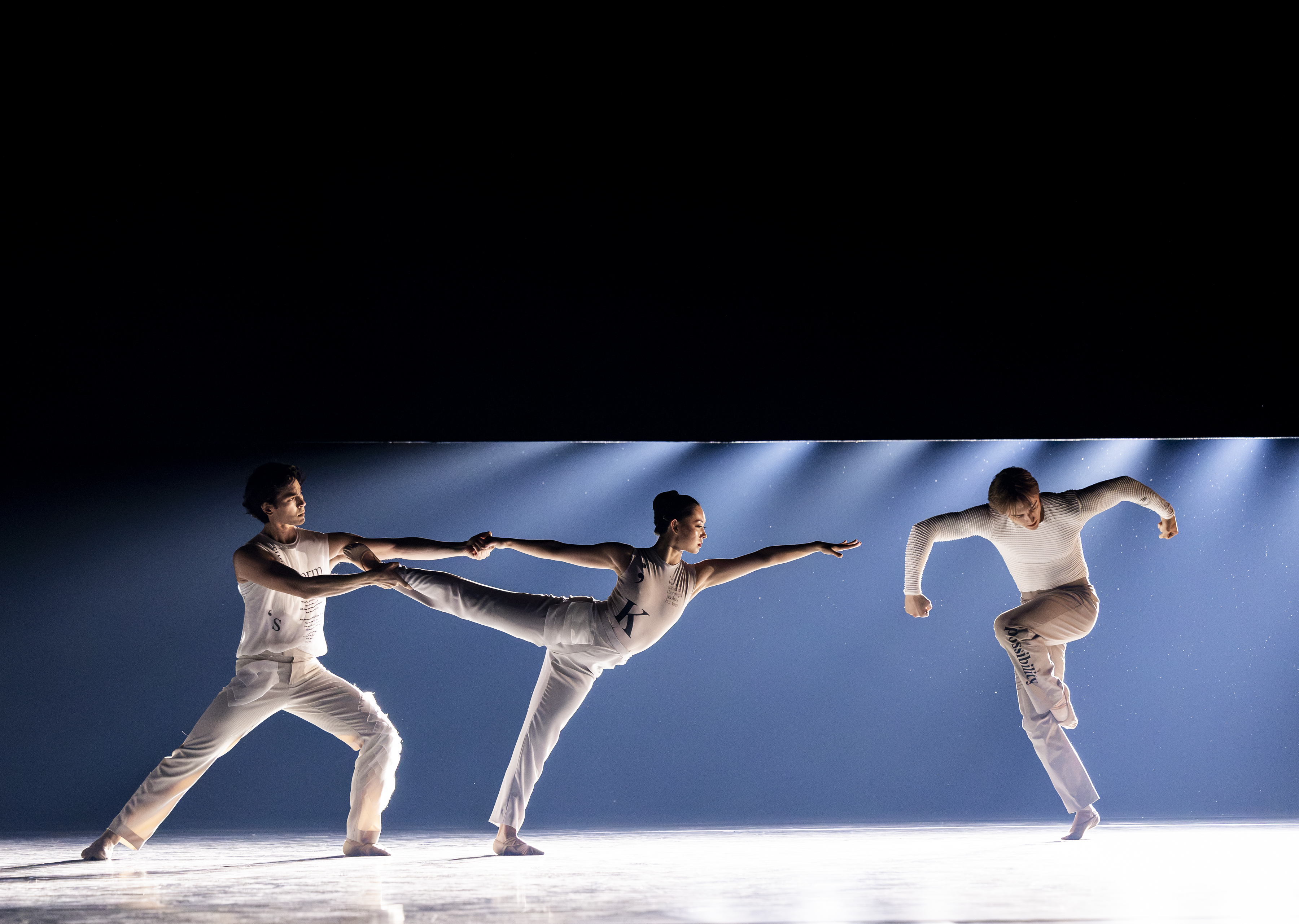
Lang’s Pages trades Tchaikovsky’s high Romance for more contemporary and urgent symphonic music paired with a voice-over of a woman listing things she feels, thinks, and does when she’s alone. Her sentences overlap and run into each other like an inner monologue. After a while, the voice begins to feel like an incantation, but its candid, occasionally humorous observations keep the whole thing from sounding too stuffy.
Balanchine’s blues yield to Lang’s white costumes, which are printed with letters, words, and punctuation marks. Each dancer seemed to represent a stray thought bubbling up, sinking down, bouncing around, or racing through the speaker’s lonely mind as she contemplates art creation, music volume levels at the house, etc.
And whereas Serenade often showed off its symmetries, such that everywhere you looked was supposed to look the same, I didn’t have the slightest clue where to look during Pages. At any given time, there were two or three groups of dancers doing different stuff, a chair hanging from the ceiling, and random clanging sounds drawing attention to the wings. I couldn’t imagine a better metaphor for trying to create art in a world of endless internal/external distractions. The whole thing looked like a dream I’d want to dream again.
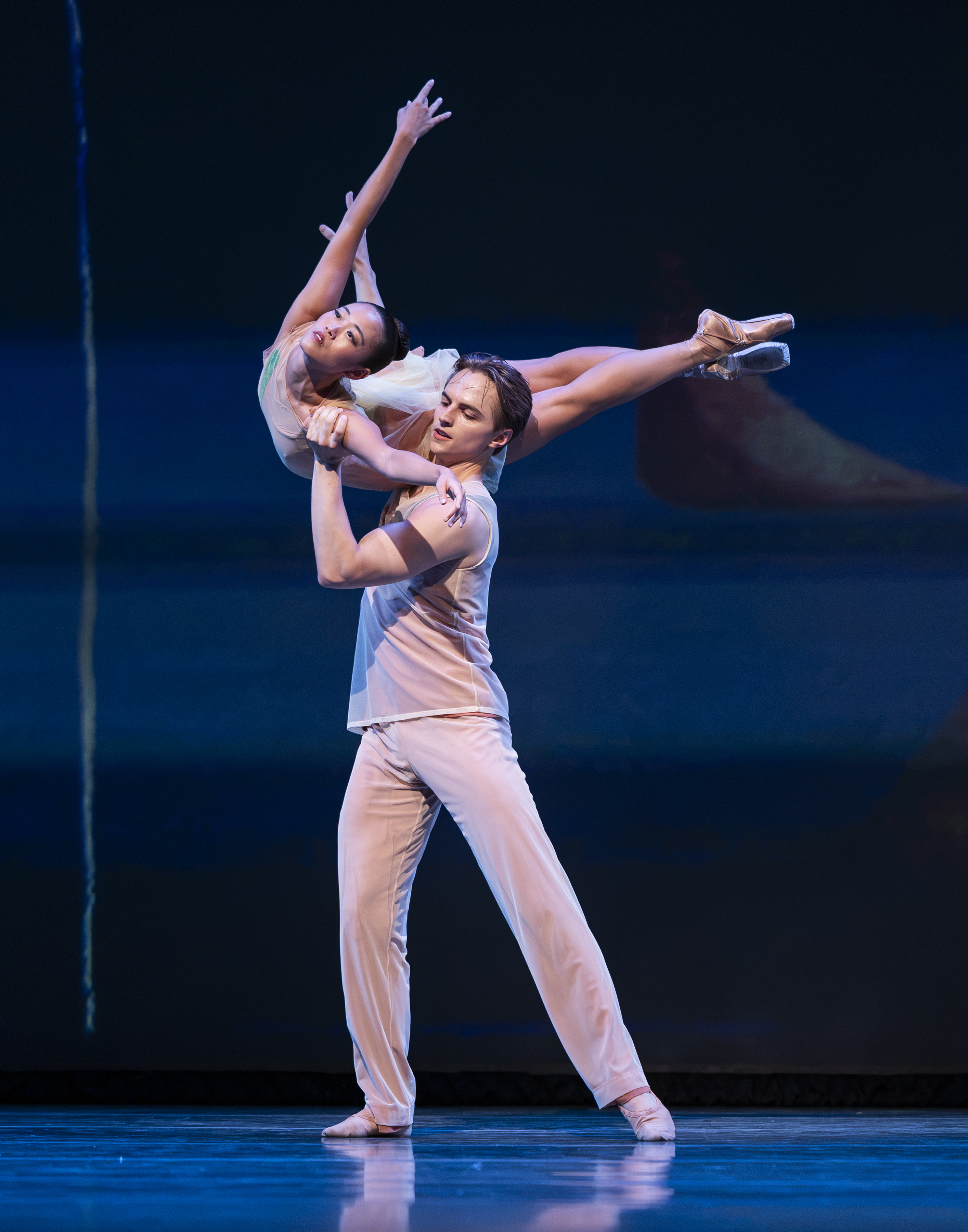
After Lang’s whiteout dream, Alexei Ratmansky’s Pictures at an Exhibition bursts onto the stage with bright splashes of color drawn from Wassily Kandinsky’s Color Study, Squares with Concentric Circles.
If Serenade celebrates the collective as one, and if Pages celebrates the multitudes in one, then Pictures at an Exhibition reasserts the individual’s prowess in a series of colorful, electric dances. In this ballet, the dancers variously move like Kandinsky’s brushstrokes and Modest Mussorgsky’s keystrokes, sometimes more in line with the music and sometimes more in line with painting.
It’s fast, it’s fun, but after the first three or four paintings, it does feel as if you’ve been walking around in an art museum a little too long.
Apart from that, 100,000 points to PNB Principal Company Pianist Christina Siemens, who handled Mussorgsky’s famous score with aplomb. And shout out to Soloist Luther DeMyer, whose hyperenergetic performance in the second promenade sequence made me sit up in my chair and say, “Now who the hell is that?” Incredible work.
Go see it! You can find affordable tickets! The high-up seats are good for this one!